
 When it comes to your home, making sure you have both a high performing and safe insulation is key!
Believe it or not, not all insulations are created equal! You may not see insulation every day, but choosing insulation is a vital part of building any structure. Ensuring that your insulation is both safe and high performing is crucial—not just for your home’s health, but for your own as well!
With this in mind, let’s explore some common insulation types that may be able to market their benefits, but shy away from the harm their insulation materials can cause. We believe that every homeowner should be aware of what they’re putting inside their walls, attics, basements, and so forth. While performance is certainly important, health and safety are too!
Spray foam is an insulation that comes in two forms, open-cell and closed-cell. Closed-cell foam is denser and more moisture-resistant than open-cell, and so it is typically used for more exterior applications and in areas with high humidity. Open-cell foam is lighter and less dense. Spray-foam is commonly marketed as having a high R-value, possessing great insulating properties, and being an airtight insulation capable of energy efficiency in your home. It’s also marketed as being a vapor retarder, restricting water vapor from passing through.

However, for all these positive properties, the material has some serious setbacks in terms of its safety. Undeniably, spray foam is made from toxic, petroleum-based chemicals. It’s a hazardous material to apply, as installers need to be dressed in fully protective clothing with access to fresh air supply, often found in the form of a respiration mask, to keep themselves protected during the application process.
Exactly what kinds of dangers and health concerns are we talking about? Well, breathing it in and being exposed to it can cause asthma, severe lung damage, potential internal complications, and, in some cases, it has proven to be fatal. A lot of spray-foam installers would tell you that the foam takes 24-72 hours to fully cure and then, after that, the danger of the material has passed. However, this curing is dependent on “ideal conditions,” which includes maintaining the right ambient temperature, maintaining suitable humidity levels, and the foam needs to possess a very specifically mixed chemical ratio. Those variables all have room to be disturbed on a job site, which could result in improper curing of the foam. It takes a very in-tune, professional installer to safely install spray foam insulation and if it’s not given the correct conditions to cure properly, it can leave room for future issues. In fact, there are numerous legal cases every year involving spray foam that wasn’t cured properly that ends up rendering homes unlivable. So, it’s important to have a qualified professional install this kind of insulation to avoid those risks.
Then we have fiberglass, which is arguably the most common form of home insulation. It’s made from sand that is then molten into glass in the form of tiny fibers, and it is definitely a safer alternative than spray foam. However, we wouldn’t call it a fully safe product, either. Because it’s made of glass fibers, these fibers can create serious issues in different circumstances.
 For starters, it has to be handled and installed with some protective clothing. This means gloves, a face mask, eye goggles, and clothing that covers every inch of skin to eliminate the risk of any exposure. Handling fiberglass without protective clothing causes skin irritation and sometimes severe rashes as the glass fibers get embedded in and under the skin. If fiberglass is breathed in at all, it can cause serious breathing and lung issues, and can be even more dangerous for those with asthma. If fiberglass gets contact with your eyes, it’s also extremely irritating and can pose a risk for developing eye problems. Finally, if ingested, it can create stomach issues and cause internal inflammation. So essentially, while you may not need intensive protective equipment to install it, you still need to be extremely careful and protected during the installation process.
Fiberglass is also known for trapping allergens, dust, and moisture. This trapped moisture can potentially lead to mold growth, which creates another set of issues and concerns later down the line. While spray foam needs to be covered after it’s installed, fiberglass technically doesn’t have to be covered. However, it’s usually advisable to cover fiberglass anyways, as any contact or disturbance of the material can involuntarily put fiberglass fibers into the air.
While fiberglass is certainly a safer alternative to spray foam, it still isn’t entirely a safe product. So even though it may be a common and well-performing insulation material, it’s still not the best option for a home when we consider its own safety hazards as well as where it falls short in its performance.
However, there exists cellulose insulation—known for being safe, sustainable, and high-performing. Nu-Wool Premium Cellulose Insulation was founded in 1949 and is the longest standing and best performing cellulose insulation on the market! Cellulose is manufactured using recycled paper and cardboard, and our cellulose insulation is treated with all-natural borate, making our product completely natural, safe, and sustainable! Because of its makeup, cellulose insulation can be fully handled without any protective equipment and won’t cause irritation or other health issues during installation. It’s so safe, you could even eat it if you wanted to, though I doubt it would taste very good! Though, during application, it can be a bit dusty so if you’re prone to dust allergies, we recommend wearing a face mask to at least prevent breathing in the dust particles.
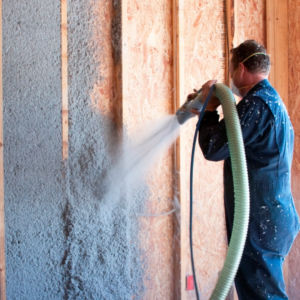 When it comes to application, Nu-Wool Premium Cellulose Insulation is typically blown-in to the wall cavity using our WALLSEAL system. It’s applied with water to help the cellulose stick inside the application space. During the process, the cellulose is also blown-in until densely covering the site. This creates a densely packed insulation, which we call “dense pack,” that fully covers and insulates the space. Our cellulose insulation can also be dry blown into attic spaces to insulate those areas of the home as well.
Nu-Wool Premium Cellulose Insulation, when dense pack applied, actually has an insulation density that surpasses the densities of both spray foam and fiberglass, having a 3.5-pound density compared to fiberglass and open-cell foam’s 0.5-pound density and closed-cell foam’s 2-pound density. This 3.5-pound density not only helps with insulating properties, but also creates better acoustical performance. Nu-Wool is known for its soundproofing qualities that other insulations simply aren’t capable of. Plus, its thicker density creates a kind of airtightness that helps with energy efficiency and creates a well-insulated space that maintains temperature. Our cellulose is also soft and flexible meaning that, as your home settles, Nu-Wool will move with it and—unlike rigid spray foam—will maintain its structure and continue insulating at its original performance for years to come. This softness and material flexibility also contributes to creating noticeably quieter spaces!
Speaking of energy efficiency, Nu-Wool offers a 10-year energy guarantee on heating and cooling bills to homes insulated fully with our product. No other insulation manufacturer offers a guarantee like this without additional fees. We will gladly stand behind our product and its reliability and consistency as an insulation! Nu-Wool Premium Cellulose Insulation performs exactly how we market it, and so we don’t shy away from guaranteeing it. It begs the question as to why other insulation manufacturers won’t stand behind their product’s performance the way we do…
 Another important aspect of insulating your home is your insulation material’s fire resistance. Spray foam needs to be protected from fire with a code-approved thermal barrier, but, like fiberglass, Nu-Wool Premium Cellulose Insulation is fire resistant. Our cellulose insulation is a Class A fire rated product designed to add crucial fire protection to a home. Most people think of paper burning easily, but with dense packed cellulose, the compact paper-based insulation is so packed in that it won’t allow air to get in it—hence airtight. Instead, it’ll flake away when exposed to flames, not burn. Dense packed wall-applied cellulose also qualifies as being a fire block by building code (2009). Nu-Wool Premium Cellulose Insulation’s natural added borates also help add fire resistance to the product, and these fire retardants last the lifetime of the structure. Our cellulose insulation can add crucial fire protection as it performs to help slow or stop the spread of flames!
All this to say, Nu-Wool Premium Cellulose Insulation is an exceptionally high performing insulation made of sustainable and all-natural materials. It’s completely safe to handle, install, and have in the spaces of your home for years to come.